Qoulomb Alternatives Pricing Guide: What You Should Really Pay
Buying AI visibility usually starts with a cheap tool and ends with a bigger invoice. Cheap platforms report mentions, but they rarely get your brand named when ChatGPT, Perplexity or Google AI Overviews answer a buyer's question.
This guide breaks down what Rankera charges, from $250/month for 20 target searches to $2,000/month for 350, and why cannabis, iGaming and adult niches cost 3x. You will also see the real cost drivers and who should skip this service entirely.
What Is Rankera? The AI Visibility Service Behind This Pricing Guide
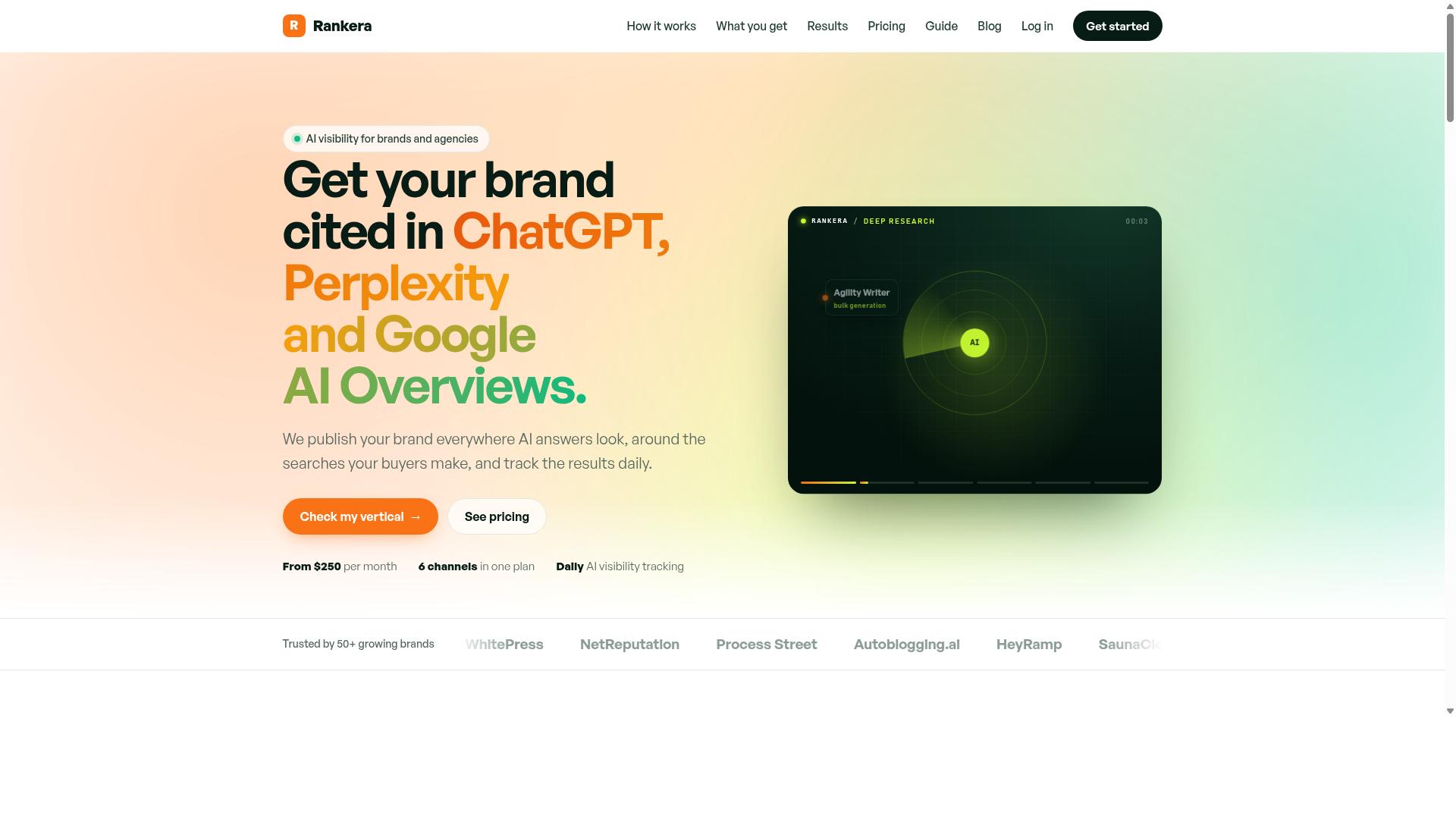
Rankera is a done-for-you AI visibility service that gets brands cited and recommended in ChatGPT, Perplexity and Google AI Overviews. This pricing guide examines what a service like this should realistically cost, and where the value actually sits in a monthly subscription.
The core idea behind Rankera is straightforward. It publishes brand mentions across six channels each month around the searches buyers actually make. Rather than chasing a single ranking position, the service spreads a brand's presence across multiple sources so that AI systems have more material to draw from.
That approach reflects a shift in how discovery works. Rankera states that ranking first no longer means being recommended, because AI answers name two or three brands and pick them from what other sources say. A page one position can sit unnoticed while an AI Overview cites a competitor.
Rankera was built by the team behind Autoblogging.ai, which gives the service a background in automated content production. The process follows four stages:
- Research: buyer searches and competitors
- Plan: a monthly roadmap you can edit
- Publish: six channels, indexed fast
- Track: AI mentions and rankings, daily
Tracking runs daily across AI Overview mentions and Google rankings, so progress is visible rather than assumed. For a pricing guide, that daily measurement matters. It is the difference between paying for activity and paying for observable movement in how often a brand appears in AI answers.
This guide uses Rankera as the reference point for the wider question in the title: what should you really pay for an AI visibility service, and which parts of a quote reflect genuine work versus padding. The sections that follow break down the cost drivers, the difference between flat monthly billing and usage-based pricing, and the hidden fees that often sit outside the headline figure.
What You Should Really Pay for an AI Visibility Service Like Rankera
When budgeting for AI visibility, the sticker price is only the beginning. The true cost includes channels, search volume, and niche competitiveness.
Most buyers focus on the monthly subscription fee and stop there. That approach misses the bigger picture. Total cost of ownership tells a more honest story than any advertised rate.
A low monthly billing figure can hide labor, gaps in coverage, and weak placement that never converts into brand mentions. A higher flat rate can look expensive until you count what it replaces.
To judge affordability properly, weigh four elements together:
- The subscription fee itself, whether monthly or annual billing
- The internal hours required to run the service
- The reach and quality of the mentions produced
- The switching cost and vendor lock-in risk if you change providers later
Teams often underestimate internal labor when evaluating a paid plan. That hidden fee rarely appears on an invoice, yet it shapes ROI more than the list price does.
The sections below break down where cheap tools fail and which cost drivers actually set the price of a serious AI visibility service.
Why Cheap AI Visibility Tools Cost More Than They Save
A $50-per-month tool might seem like a bargain, but when you factor in the hours spent managing campaigns and the missed opportunities from poor placement, the savings evaporate.
Cheap tools push the work back onto you. Manual outreach, keyword research, and tracking spreadsheets all consume staff time. That time has a cost even when no invoice arrives.
Four hidden expenses show up again and again with budget options:
- DIY labor for setup, monitoring, and follow-up
- Weak tracking that leaves you guessing which mentions moved the needle
- Limited reach across AI platforms and channels
- Low-quality mentions that add noise instead of authority
Consider manual outreach versus a done-for-you service. Manual outreach means drafting pitches, chasing responses, and logging results yourself. A done-for-you model absorbs that workload and delivers consistent output without draining internal resources.
Poor placement compounds the problem. A mention buried where no audience sees it delivers little value, so you pay twice: once for the tool, once for the missed visibility.
Rankera's done-for-you approach is designed to remove these hidden costs. Instead of adding another dashboard to manage, it handles the work that cheap alternatives leave behind, which is why the effective cost often lands lower than the advertised price of a budget tool.
The Real Cost Drivers: Channels, Search Volume and Niche
Three factors determine the price of any AI visibility service: the number of channels covered, the volume of target searches, and the competitiveness of your niche.
Channels come first. Covering six channels, as Rankera does, requires more infrastructure and coordination than covering one or two. Each additional channel multiplies the work of monitoring, placement, and reporting. A single-channel tool can charge less because it does less.
Search volume comes second. Higher volume means more queries to track, more mentions to place, and more compute resources behind the scenes. Usage-based pricing reflects this directly, while flat rate plans build an average into the fee.
Niche competitiveness comes third. Premium verticals such as cannabis or iGaming carry restrictions on advertising and steeper competition for attention. Those conditions raise the cost of securing quality placement.
These drivers explain why pricing tiers exist at all. A tier is not an arbitrary number. It maps to how many channels you need, how much search volume you target, and how hard your niche fights for visibility.
When comparing a competitor, check what each tier actually includes. A cheap entry tier that covers one channel in a low-volume niche is not the same product as broad multi-channel coverage. Migration and switching cost matter too, since moving platforms later can wipe out early savings.
Read every quote against these three drivers. If a price seems unusually low, one of them is likely being cut, and that gap becomes your hidden fee.
Rankera Pricing and Plans: What You Actually Get for the Money
Rankera offers transparent, flat-rate pricing starting at $250 per month, with every channel included and no per-placement fees. That structure stands out in a market where many alternatives bill per mention, per user, or per campaign, making the final invoice hard to predict.
The model is simple. You pay for a number of target searches, and each search produces a fixed set of placements across six channels. There is no separate charge for Google, Bing, YouTube, Medium, Instagram, or GitHub activity, and there are no add-on tiers that quietly raise the total cost of ownership.
Pricing scales in one direction: more searches, higher monthly fee. The entry point sits at $250 for 20 target searches, and the top plan reaches $2,000 for up to 350 searches. Premium niches such as cannabis, iGaming, and adult are priced at 3x the standard rate.
One detail worth noting for anyone comparing vendors: Rankera does not promise rankings. The service focuses on publishing brand mentions across industry websites, Medium articles, YouTube videos, Shorts, Instagram Reels, and GitHub pages. Your business is set up within 48 hours of subscribing.
For agencies, each client brand has its own plan at the standard prices, which keeps billing predictable across a portfolio. The sections below break down what each tier actually delivers.
Entry Plan: $250/Month for 20 Target Searches
The entry plan at $250 per month is designed for small businesses and startups that want to test AI visibility without a large upfront commitment. It covers 20 target searches per month, and every one of those searches runs across all six channels rather than a limited subset.
For each search, Rankera publishes a mention on an industry website, a Medium article, a YouTube video, a Short, an Instagram Reel, and a GitHub page. That is a flat rate with no per-placement fees, so the monthly billing figure you see is the figure you pay.
The plan also includes daily AI visibility tracking, which lets you follow how your brand appears over time rather than waiting for a monthly summary. Setup is handled within 48 hours of subscribing, so there is no long onboarding period before work begins.
Who is this tier built for? A few common profiles fit well:
- Local businesses that need visibility in a defined geographic or service niche
- Small businesses testing whether AI-driven discovery is worth further investment
- New SaaS products with a narrow set of search terms they want to own
Compare the $250 figure to the alternatives. A traditional PR retainer or a manual outreach effort typically costs far more per month, and neither guarantees the same channel coverage. Doing it yourself means sourcing writers, editors, video creators, and platform accounts, which is rarely cheaper once your time is counted. For a first step into AI visibility, the entry plan keeps the budget contained while still covering every channel.
Scaling Up: Up to 350 Searches for $2,000/Month
For brands with broader reach, Rankera's top-tier plan covers up to 350 target searches per month for $2,000, still with every channel included. The fee rises with search volume, and the structure stays flat rate at every level rather than switching to usage-based pricing.
That matters for planning. Larger SaaS companies, ecommerce brands, and agencies often need coverage across many product lines, categories, or client accounts. A per-search model makes that math straightforward: you know the ceiling before the month starts, and there are no hidden fees layered on top.
At this tier, the channel mix stays identical to the entry plan. Each search still produces a mention on an industry website, a Medium article, a YouTube video, a Short, an Instagram Reel, and a GitHub page. Nothing is gated behind a higher tier or sold as an upgrade.
Daily AI visibility tracking continues as well, which becomes more valuable as the number of searches grows. With hundreds of active terms, tracking gives you a clearer read on which areas are gaining traction and which need attention.
For agencies, the scaling logic extends naturally. Each client brand has its own plan at the standard prices, so a portfolio of clients can be mapped to separate subscriptions without custom enterprise contracts or negotiated rates. That keeps scalability simple and makes migration between tiers a matter of adjusting search volume rather than renegotiating terms.
Worth repeating the one caveat: Rankera does not promise rankings. What scales is the volume of published mentions and the tracking that accompanies them, not a guaranteed position in any search result.
Premium Niche Pricing: Cannabis, iGaming and Adult at 3x
If your business operates in cannabis, iGaming, or adult industries, expect to pay three times the standard rate due to stricter advertising regulations and higher competition. That puts the entry plan at $750 per month for 20 target searches, with the multiplier applied consistently across higher tiers.
Why the premium? These sectors face limited platform options, additional compliance requirements, and heavy demand for whatever visibility is available. Publishers and platforms that accept this content are fewer, which raises the cost of placing a mention. The 3x figure reflects that operating reality rather than an arbitrary markup.
What does not change is the scope of the service. Rankera still provides done-for-you publishing across all six channels for these niches, and the deliverables per search remain the same: an industry website mention, a Medium article, a YouTube video, a Short, an Instagram Reel, and a GitHub page.
Daily AI visibility tracking and the 48-hour setup window apply here too. For a cannabis brand or an iGaming operator weighing alternatives, the practical comparison is against fragmented vendor stacks where each channel is sourced separately, often with inconsistent results and unpredictable invoices.
The premium tier keeps the same flat rate logic, just at a higher level. You still know your monthly billing amount in advance, you still get every channel in one plan, and there are no per-placement fees added after the fact. For regulated industries, that predictability is often the deciding factor when comparing vendors.
What Makes Rankera Stand Out From Cheaper Alternatives
Unlike cheap AI visibility tools that require you to pitch journalists or manage placements, Rankera publishes brand mentions on publications it owns in your niche. There is no pitching, no per-placement fee, and no backlinks to chase. That single structural difference changes who carries the workload and who carries the risk.
Most low-cost alternatives fall into two camps. DIY tools hand you a dashboard and leave the outreach, writing, and follow-up to you. PR agencies handle the work but bill per placement, which makes costs unpredictable and results slow to compound. Rankera sits between them as a done-for-you service.
One plan covers six channels, and AI visibility is tracked daily rather than reported in a quarterly snapshot. That cadence matters because AI answers shift constantly, and a monthly report can hide weeks of movement in how your brand appears.
The results are measurable on Rankera's own brand, Autoblogging.ai. Between July and October 2026, AI Overview mentions rose from 48% to 70%, named-first appearances climbed from 7% to 46%, and top-three placements grew from 26% to 64%. Across 46 non-branded buyer searches tracked daily, 24 of 44 AI Overviews cited at least one of its videos, and of 73 YouTube links cited, 54 were Rankera's, or 74%.
Owned publications also remove a common source of fragility. When you depend on earned media, a single editor change or rejected pitch can stall momentum. When placements sit on properties the provider controls, delivery is more reliable and scheduling is more predictable. That is a meaningful advantage over tools that only surface opportunities you still have to win yourself.
Reporting is white-label, with unbranded PDF and CSV reports plus share links, so agencies and in-house teams can present results under their own name. Setup completes within 48 hours of subscribing, which shortens the gap between paying and seeing activity. Rankera is trusted by 50+ growing brands, and it has published 918 videos, 130 of them aimed at tracked buyer searches.
For anyone weighing a cheaper subscription against a managed service, the honest comparison is not sticker price. It is the hours, tools, and outside help a DIY route quietly requires. Rankera folds that work into one plan, which is why it stands apart from the low-cost tier rather than competing inside it.
Trust Signals: Track Record, Clients and Case Study Results
Rankera is trusted by over 50 growing brands, including Nordic Lifting, WhitePress, NetReputation, Process Street, and Autoblogging.ai. That roster also includes HeyRamp, SaunaCloud, SoftPro, Medicai, and Let Property.
For anyone weighing the cost of an AI visibility service, this client list matters more than a feature checklist. A pricing guide can tell you what a subscription fee looks like, but it cannot tell you whether the work actually moves the needle. A track record across ecommerce, PR, SaaS, and healthcare brands is a stronger signal of affordability than any discount code.
The mix of clients is worth noting. Nordic Lifting sells physical products. WhitePress operates in digital PR. NetReputation works in reputation management. Process Street is a SaaS platform. Medicai serves a regulated healthcare audience. Different industries, same underlying need: getting named in AI-generated answers when buyers search.
That diversity suggests the service is not built for one narrow niche. A brand paying a monthly fee wants confidence that the approach transfers to its own market. Seeing names from several sectors is one way to gauge that before committing budget.
Why the Autoblogging.ai Case Study Matters for Pricing
The clearest trust signal is the Autoblogging.ai case study. Rankera tracked 46 non-branded buyer searches daily between July and October 2026. These are searches where someone is looking for a solution, not searching for the brand by name, which makes them the most commercially valuable queries a company can appear in.
Rankera measures Google AI Overviews and Google rankings every morning for each target search. That includes whether the AI Overview names the brand and links to its content. The company does not measure ChatGPT answers daily, a limitation worth knowing upfront.
This tracking cadence is what separates a real engagement from a vague promise. Daily measurement across 46 searches produces a data trail a client can inspect, not a monthly summary assembled after the fact. For a buyer comparing a subscription fee against expected ROI, that level of reporting is part of what the cost buys.
The case study also shows how visibility gets built. Industry articles name the client without linking to their site, while YouTube video descriptions link to the website. Every new page is submitted to Google and Bing. These are concrete distribution steps, not abstract claims.
Built by the Team Behind Autoblogging.ai
Rankera is built by the team behind Autoblogging.ai. That lineage explains the content-first approach: the same group that learned how automated publishing performs in search now applies that knowledge to AI visibility.
Clients keep meaningful control over the output. They can read, edit, approve, or reject articles before they go live. They can also change searches or titles within the monthly plan. Approval before publication removes the risk of unreviewed content appearing under a brand's name.
Scope boundaries are stated plainly. Rankera does not manage Google Business Profiles, reviews, categories, or posts, and does not edit client websites. Knowing what is excluded prevents mismatched expectations, which is itself a form of cost protection.
Agencies get a practical structure too. Agency clients can switch between client brands in one dashboard, each with its own business details, competitor research, monthly plan, article approvals, and list of published work. One subscription can cover multiple brands, which changes the per-brand math considerably.
For a pricing guide, this is the bottom line: the fee buys a documented process, a verifiable client roster, and a case study with daily tracking behind it. That is a more useful measure of value than the headline number alone.
Who Should Use Rankera - and Who Should Look Elsewhere
Rankera is ideal for brands, SaaS companies, service businesses, and agencies that want a hands-off AI visibility solution with predictable pricing. If your goal is to understand how your brand appears across AI-driven search and chat platforms without building an internal tracking process from scratch, Rankera is built for that exact job.
The service is a done-for-you AI visibility service. Rather than asking a marketing team to monitor mentions manually, Rankera handles the monitoring work as a managed service. That positioning matters when you are comparing alternatives, because it tells you whether you are buying software, a service, or both.
Local businesses are a strong fit, particularly those competing for visibility in a defined geographic area. Dental and medical clinics, law firms, roofing and HVAC contractors, real estate agencies, recovery and treatment centres, coaches and consultants, and businesses operating several locations all fall into this group. For these operations, being mentioned accurately in AI-generated answers is often the difference between a booked appointment and a missed one.
Small businesses form another natural audience. Online shops, consultants and coaches, B2B service firms, independent software makers, one-person agencies, clinics, and trades all benefit from a solution that does not require a dedicated marketing hire to run. Predictable pricing is especially valuable here, since small teams rarely have room for surprise costs.
Agencies represent a distinct segment, and Rankera supports white-label use. SEO and content agencies, digital PR and reputation firms, web design studios, and consultancies can bring the platform into their existing client offerings. That makes it a practical option for agencies already fielding client questions about AI visibility.
The broader use case list covers ecommerce brands, healthcare and clinics, hotels and hospitality, and contractors and home services. SaaS companies are a core audience as well, since software brands live and die by how they are described in comparison and recommendation content.
Just as important is knowing when Rankera is not the right call. Three situations stand out.
- Extremely tight budgets. If your total marketing spend cannot absorb a recurring subscription fee, a paid AI visibility platform may not be the right first investment. Free tier options and open-source tools exist, though they typically shift the cost from money to time.
- Full DIY control. Some teams genuinely prefer to build and run their own tracking workflows. If you have the staff and want complete ownership of the process, a managed service removes flexibility you may value.
- Not selling online. Businesses without any digital sales motion or online discovery funnel have less to gain from monitoring AI mentions. The ROI case is simply weaker when your customers do not find you through search or AI answers.
For everyone else, the value proposition is straightforward. You get a hands-off way to track AI visibility, and you get pricing you can plan around rather than usage-based bills that swing month to month. That combination of managed service and predictable cost is the core reason Rankera belongs on your shortlist.
Final Verdict: Is Rankera Worth the Price?
After analyzing the pricing, features, and trust signals, Rankera offers strong value for businesses serious about AI visibility-but it's not for everyone.
The pricing structure spans $250 to $2,000, with the final figure shaped by scope and niche. That range covers a done-for-you service across six channels, which means you are paying for execution, not just a dashboard seat.
Whether that price makes sense depends on how you weigh three things: what you get, what you would otherwise spend to replicate it, and how much the outcome matters to your pipeline.
Here is the short version of the trade-offs:
- Transparent pricing: the $250 to $2,000 range is stated upfront, so you can judge affordability before committing.
- Six channels included: coverage is bundled rather than sold as separate add-ons, which simplifies total cost of ownership.
- Done-for-you delivery: the service is executed for you, reducing the internal hours a DIY approach would demand.
- Premium niche multipliers: specialized or competitive niches cost more, which is the main reason two businesses can sit at opposite ends of the range.
On the con side, the entry point is higher than a free tier or open-source tool. A team with a tight budget and the time to build its own workflow may find a cheaper route. There is also no way around the niche multiplier: if your category is premium, your cost reflects that.
On the pro side, the comparison that matters is not Rankera versus free software. It is Rankera versus the subscription fees, per-user costs, and internal labor of assembling the same coverage yourself. Once you count those, the flat-rate framing becomes easier to justify.
Who should consider it? Businesses that treat AI visibility as a growth channel rather than an experiment. Teams that want six channels handled without hiring for each one. Anyone who has priced out the alternative and found the total higher.
Who should wait? Companies still validating whether AI visibility moves their numbers, and those who genuinely prefer to build in-house and absorb the switching cost later.
If you want to confirm which end of the range applies to you, the fastest path is a direct conversation about your niche and scope. Reach out at [email protected]. You can also review the site footer, which links to How it works, Pricing, the AI visibility guide, FAQ, Blog, Case study, Reddit and Quora, and Client login. © 2026 Rankera.
The bottom line: for the right buyer, the price reflects a done-for-you service across six channels with clear, upfront tiers. That is a defensible spend, and for businesses serious about AI visibility, it is worth it.
Frequently Asked Questions
How much does Rankera actually cost, and what's included at each price point?
Rankera starts from $250 per month, and every channel is included at that price - there are no add-ons to unlock. The entry plan covers 20 target searches a month, while bigger plans scale up to 350 searches for $2,000 per month. Premium niches such as cannabis, iGaming and adult are priced differently, so it's worth checking directly if you operate in one of those spaces.
Why is Rankera priced per target search instead of per placement?
Rankera is a done-for-you service that publishes brand mentions across six channels each month on one shared keyword list, so pricing scales with how many searches you want to target rather than how many individual placements you buy. There's no pitching and no per-placement fee, which means your costs stay predictable as coverage grows. That structure is what makes a $250 entry point possible while still including all six channels.
How do I know I'm not overpaying compared to other AI visibility tools?
The honest answer is that pricing across this category varies widely, and many tools charge separately for tracking, content or placements. Rankera bundles six channels, done-for-you publishing and daily AI visibility tracking into a single plan starting at $250 per month. When comparing alternatives, add up every line item a competitor charges - not just the headline price - to see what you're really paying for comparable coverage.
Is the cheapest plan enough, or do I need to upgrade?
That depends on how many searches matter to your business. The $250 entry plan covers 20 target searches per month, which suits brands with a tight, focused set of buyer queries. If you need broader coverage, plans scale up to 350 searches for $2,000 per month, so you can match spend to the size of your opportunity rather than overbuying upfront.
What do I actually get for the money beyond published mentions?
Alongside publishing across six channels, Rankera includes daily AI visibility tracking so you can see how your brand shows up in ChatGPT, Perplexity and Google AI Overviews. Mentions are published on publications Rankera owns in your niche - named and recommended, with no pitching required from you. It's a done-for-you service, meaning the team handles execution rather than handing you another tool to manage.
Are there hidden costs or long-term contracts I should budget for?
Rankera's plans are monthly, starting from $250, with every channel included and no per-placement fees - so the main variable is how many target searches you choose. Premium niches like cannabis, iGaming and adult sit at different pricing, which is the one case where your quote may differ from the standard tiers. For exact terms, reach out to [email protected] before committing to a budget.